

Enterprise Architecture (EA) isn’t universally suited for every organization, especially in its traditional form. Many of today’s tech unicorns prefer a more agile approach, where Technical and Solution Architects fulfill the role of pseudo-Enterprise Architects as needed. This trend stems from several factors:
- Establishing a traditional EA practice typically takes 18 months to two years, followed by another one to two years to refine and develop it further.
- Organizations committing to EA must have a long-term strategic vision. This dedication can sometimes hinder their ability to swiftly adapt and implement rapid process changes.
However, for organizations recognizing the need for EA, assessing its maturity becomes crucial in ensuring its effectiveness within the organization. So, how do we measure this maturity?
Firstly, let’s grasp EA at a high-level view. At its core, EA involves documenting the current state of the organization, aligning with its strategy, vision, and architectural elements, and charting a future state. There exist various frameworks and models for this process, which we’ll explore in a future article.
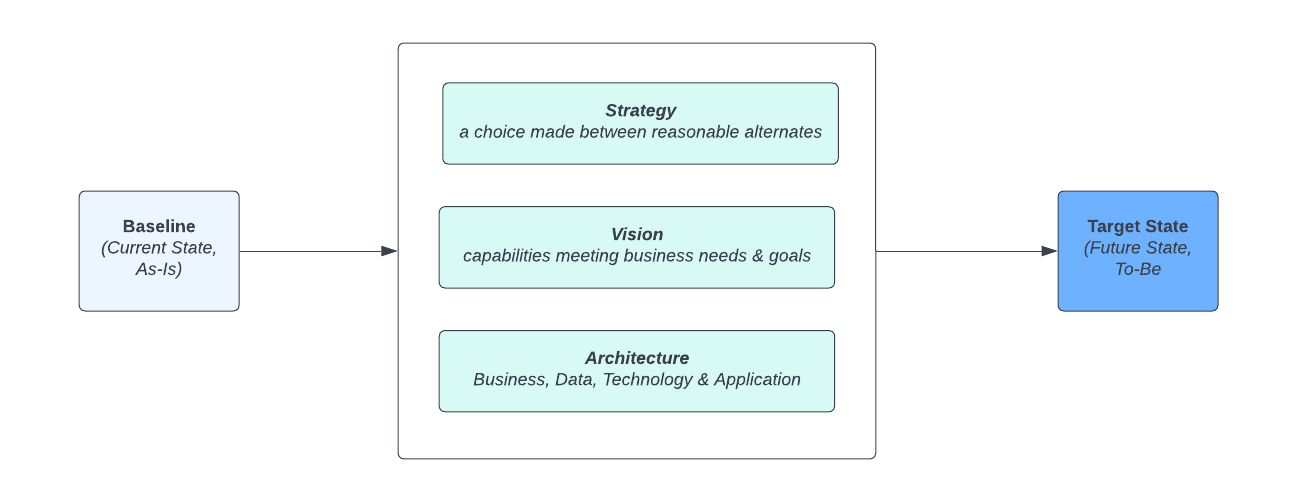
The EA discipline encompasses five primary sub-categories essential for aligning with enterprise strategic goals:
1. Architecture Governance: Architecture governance involves practices, processes, and policies to ensure that an organization’s architectural direction aligns with its business objectives. It includes setting standards, guidelines, and decision-making processes for managing the creation, evolution, and implementation of architectural assets.
2. Business Architecture: Business architecture provides a conceptual blueprint of an organization from a business perspective. It outlines how the organization generates value, including its business processes, capabilities, organizational structure, and strategic goals. This blueprint helps in aligning business strategy with operational execution.
3. Information Architecture: Information architecture focuses on designing the structure of shared information environments such as websites, intranets, and software applications. Its aim is to organize, categorize, and label information to enhance usability and findability, thereby enabling efficient navigation and understanding.
4. Infrastructure Architecture: Infrastructure architecture encompasses designing and configuring an organization’s foundational technology components and systems, including hardware, software, networks, and data centers. It ensures reliability, scalability, and performance of the underlying infrastructure supporting applications and services.
5. Application Architecture: Application architecture concentrates on the design and structure of individual software applications or systems within an organization. It defines components, modules, interfaces, relationships, and technologies used, addressing concerns like scalability, security, and maintainability to optimize software development and deployment.
A mature EA discipline transcends mere policies and standards, fostering a collaborative culture that drives innovation. It deeply integrates with business processes to uncover key success drivers. Information Architecture, for instance, extends beyond data organization to establish a shared understanding of the organization’s information landscape. Similarly, Infrastructure Architecture ensures a flexible and scalable foundation for growth, going beyond basic system design. Application Architecture focuses on developing adaptable solutions that evolve with business needs, rather than static software solutions.
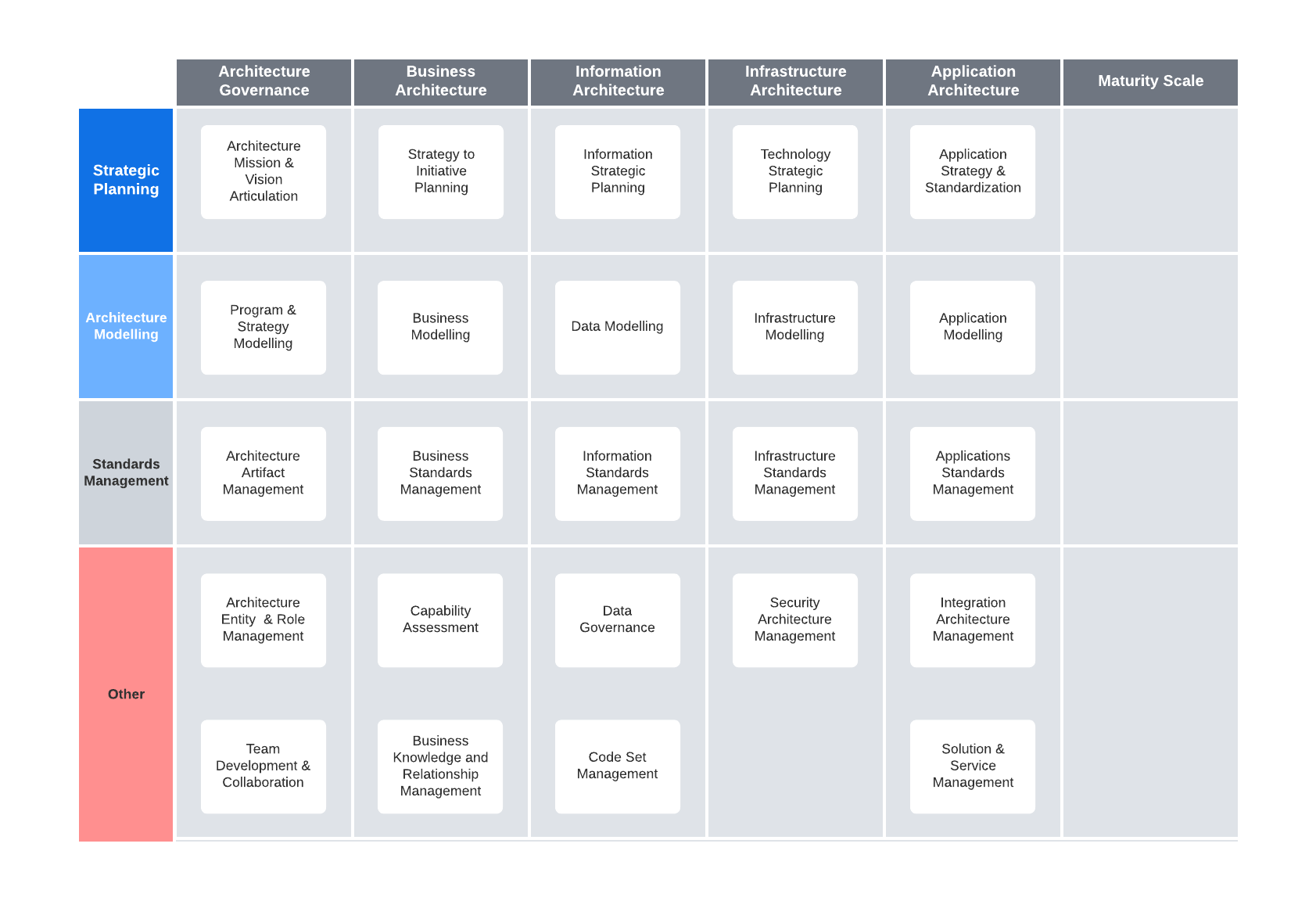
In my experience, establishing such maturity involves developing frameworks like the matrix I created to assess and advance EA within a previous organization. Given a clean slate and leveraging my TOGAF certification, I initiated this process with a thorough current state analysis before planning the required digital transformations and future roadmaps. While TOGAF standards guided my approach, I recognize the flexibility to adapt similar matrices to different organizational models and requirements.
For further reading on EA frameworks and standards:
ITScore Overview for Enterprise Architecture (gartner.com)
The TOGAF® Standard — Digital Edition — Introduction (opengroup.org)

 Krishna Avva's Cogitations