
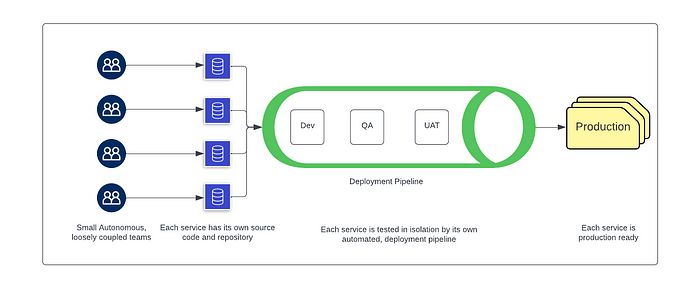
In the landscape of enterprise software development, the integration of data, services, and systems has been continually evolving. From the era of point-to-point integration to the adoption of Enterprise Service Bus (ESB) using Service-Oriented Architecture (SOA), and now to the widespread acceptance of Microservices, the journey has been marked by the pursuit of scalability, agility, and resilience.
Microservices, as an architectural approach, offer a paradigm shift by decomposing applications into small, independent services that are developed, deployed, and scaled independently. However, to harness the full potential of Microservices, it’s essential to adhere to certain principles that guide their design and implementation.
Principles of implementing a Microservice:
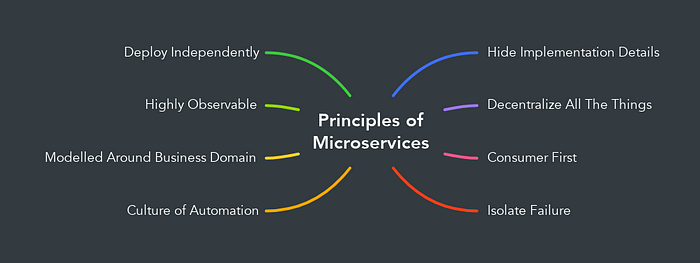
Deploy Independently:
One of the fundamental principles of Microservices architecture is the ability to deploy each service independently. This enables teams to release updates and bug fixes without impacting other services, fostering agility and reducing time-to-market. By decoupling deployment pipelines, teams can iterate rapidly and respond to changing business requirements more effectively.

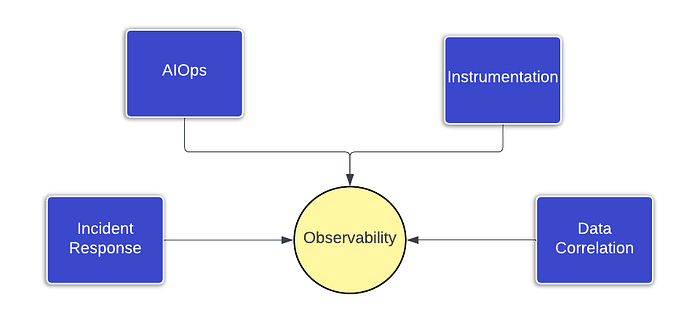
Highly Observable:
Observability is paramount in a Microservices environment. With numerous independent services interacting with each other, it becomes crucial to have comprehensive monitoring and logging mechanisms in place. Observability encompasses monitoring metrics, logging events, and tracing requests across services, allowing teams to identify and troubleshoot issues efficiently. Implementing tools like Prometheus, Grafana, and Jaeger can enhance observability and provide insights into system behavior.
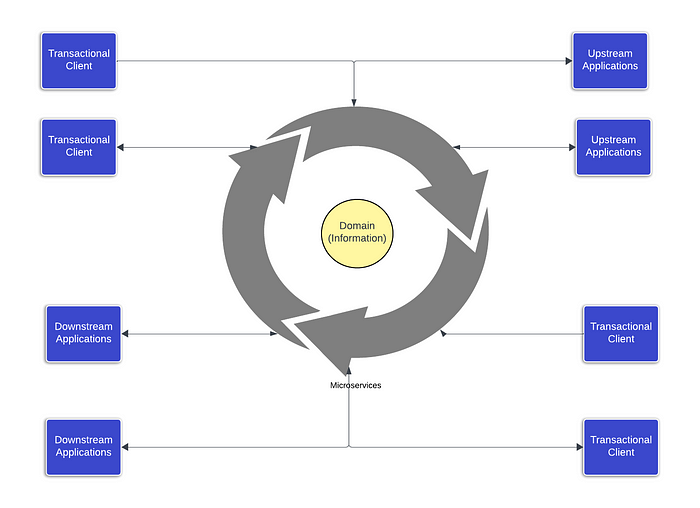
Modeled Around Business Domains:
Microservices should be designed around specific business domains rather than technical concerns. This approach, known as domain-driven design (DDD), aligns services with the organizational structure and business processes, facilitating better understanding and ownership. By encapsulating domain logic within services, teams can achieve higher cohesion and autonomy, leading to more maintainable and scalable systems.
Culture of Automation:
Automation is a cornerstone of Microservices architecture. From continuous integration and deployment (CI/CD) pipelines to infrastructure provisioning and configuration management, automation streamlines development workflows and ensures consistency across environments. Adopting infrastructure as code (IaC) practices, containerization with Docker, and orchestration using Kubernetes can automate deployment and scaling of Microservices, enabling rapid iteration and resilience.
Hide Implementation Details:
Microservices should expose well-defined interfaces while hiding implementation details. This abstraction layer shields consumers from the complexities of service internals, promoting loose coupling and encapsulation. API gateways serve as entry points to the Microservices ecosystem, abstracting service discovery, authentication, and routing concerns. Additionally, adopting API versioning and backward compatibility ensures smooth evolution of services without breaking existing clients.
Decentralize All the Things:
Decentralization is a core principle in Microservices architecture, empowering teams to make autonomous decisions and innovate at their own pace. Rather than relying on centralized governance and coordination, decentralized architectures distribute decision-making authority, fostering a culture of ownership and experimentation. Microservices teams are responsible for the full lifecycle of their services, from design and development to deployment and operations, enabling faster innovation and adaptation.
Consumer First:
Microservices should prioritize the needs of their consumers, whether they are internal applications, external partners, or end-users. By adopting a consumer-driven contract approach, services define clear expectations and constraints for their consumers, promoting compatibility and interoperability. Feedback loops between service providers and consumers facilitate iterative improvements and ensure alignment with business requirements.
Isolate Failure:
Failure isolation is critical in distributed systems, where failures are inevitable. Microservices should be designed with fault tolerance and resilience in mind, minimizing the blast radius of failures and preventing cascading effects. Implementing circuit breakers, retries, and graceful degradation strategies can mitigate the impact of service failures and maintain system stability under adverse conditions.
Conclusion:
In conclusion, the principles outlined above serve as guiding principles for designing and implementing Microservices architectures that are scalable, resilient, and adaptable to changing business needs. By adhering to these principles, organizations can unlock the full potential of Microservices and build robust, future-proof systems that drive innovation and competitive advantage.
References:
Principles of microservices architecture design — Guo’z Space (wordpress.com)
Principles for Microservice Design: Think IDEALS, Rather than SOLID (infoq.com)
5 design principles for microservices | Red Hat Developer
Principles for Microservice Design: Think IDEALS, Rather than SOLID — InfoQ

 Krishna Avva's Cogitations