
In the early 2000s, SaaS felt like liberation. Teams could procure specialized software in days instead of waiting months for internal builds. That autonomy came with a cost. By the 2020s, many enterprises were juggling hundreds of subscriptions, overlapping features, integration debt, fragmented data, and security blind spots.
Now, a second shift is underway: the rise of AI agents. These autonomous digital workers can reason, plan, and act across systems. They promise efficiency and orchestration at a scale SaaS alone could not achieve. But if we are not intentional, we risk trading one form of chaos for another — this time, “agent sprawl.”
This is not a story of hype or inevitability. It is a story about architecture, governance, and how we can avoid repeating the mistakes of the SaaS era.
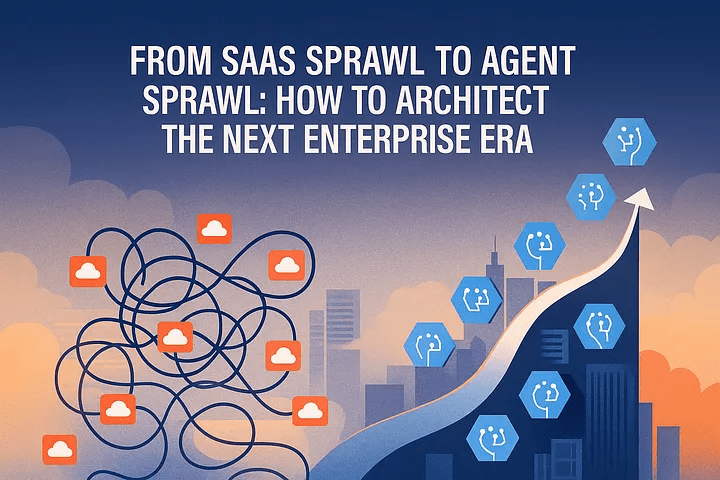
The Legacy of SaaS Sprawl
SaaS transformed how enterprises bought technology. It gave agility to business units that once relied on IT backlogs. But the rapid decentralization of procurement created an invisible tax: SaaS sprawl.
By 2025, the average enterprise manages more than 200 SaaS applications. Many organizations report that up to half of their paid licenses go unused. In some cases, shadow IT — software purchased without central approval — accounts for nearly 40 percent of deployed apps. Costs balloon silently, and few leaders have a clear picture of their full SaaS landscape.
The pain points are familiar:
- Redundant features and user confusion: Different SaaS platforms with overlapping technical capabilities.
- Fragmented data and analytics: Multiple data models, inconsistent schemas, manual reconciliation. IT often buys more reporting tools to compensate for these gaps.
- Integration debt: Brittle connectors and expensive middleware maintenance.
- Security and compliance exposure: More APIs, tokens, and access surfaces to manage.
- Operational bloat: Vendor management, renewals, and monitoring spread thin across departments.
- Limited visibility into cost and duplication: Architects struggle to identify redundant platforms — a growing nightmare at scale.
SaaS sprawl happened because tactical decisions outpaced architectural oversight. The “buy, don’t build” revolution became a patchwork of isolated apps that hinder transformation.
The Rise of AI Agents
AI agents represent the next evolution in enterprise software. Unlike static apps, they can reason, plan, and execute tasks across systems. Think of them as intelligent digital workers: they interpret goals, decompose tasks, and act autonomously within defined boundaries.
Advances in large language models, vector databases, and orchestration frameworks now make this shift possible. Early deployments already exist in IT support, finance reconciliation, sales prospecting, and operations. Enterprises are experimenting with internal “agent marketplaces” where teams can select prebuilt agents to automate routine workflows.
These agents are not just chatbots. They combine reasoning, memory, and tool use to orchestrate across APIs and data systems. They can:
- Learn from feedback and adapt to new inputs.
- Integrate across silos through APIs and events.
- Scale autonomously once properly governed.
For many organizations, AI agents are not optional — they are the next logical step in automating complexity.
What AI Agents Solve (and What They Don’t)
AI agents bring several advantages over traditional SaaS. They can unify fragmented processes, reason across tools, and operate in real time.
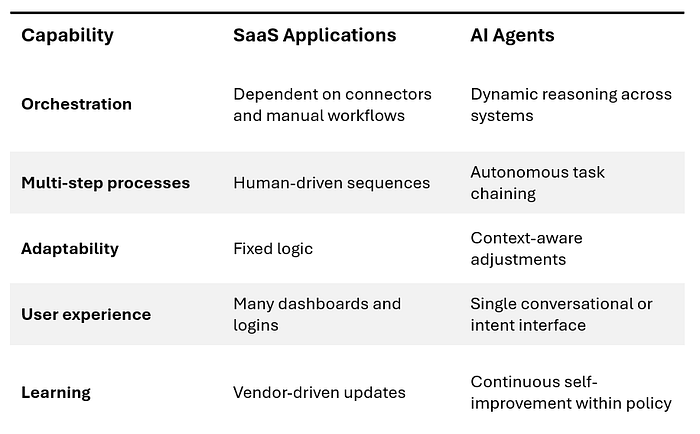
However, agents are not magic. They inherit new challenges:
- Dependence on clean, real-time data.
- Limited compatibility with legacy systems lacking APIs.
- Latency, consistency, and transaction integrity concerns.
- Risks like prompt injection, memory poisoning, and drift.
- Explainability and observability requirements that most IT stacks are not yet equipped to handle.
- Legal and compliance risks tied to how AI agents process sensitive or regulated data.
AI agents can consolidate workflows, but without governance, they can fragment control even further. The same forces that caused SaaS sprawl — ease of deployment and decentralization — can easily reappear.
SaaS or Agents? The Right Framework for Choice
The future is not “SaaS versus AI.” It is hybrid.
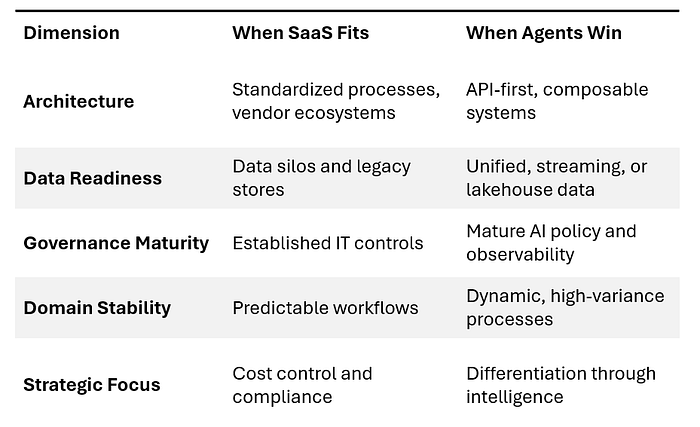
Enterprises should expect an evolution:
- Embed AI features into existing SaaS products.
- Layer orchestration agents across existing tools.
- Build or adopt an internal agent marketplace.
- Mature into a governed, multi-agent architecture.
Each step should come with explicit governance, data controls, and audit mechanisms.
Guardrails: Avoiding Agent Sprawl
To prevent a repeat of the SaaS era, enterprises must design governance before deployment. Here are the critical layers:
Security and Threat Mitigation
Treat every agent as an independent actor with scoped permissions.
Audit actions, isolate privileges, and monitor for drift or injection attacks.
Use Red Teaming to test behavior and implement rollback mechanisms.
Explainability and Observability
Log reasoning steps, memory states, and tool calls.
Track deviations, detect anomalies, and surface decision context to humans.
Implement versioning and drift detection at the model and policy levels.
Governance and Policy
Define boundaries between “assist mode” and “autonomous mode.”
Create controller agents or human overseers for sensitive actions.
Build escalation pathways and transparency dashboards.
Scalability and Coordination
Avoid uncontrolled agent creation.
Centralize registration, ownership, and lifecycle management.
Coordinate agents through a shared policy and event bus.
Change Management
Train teams to collaborate with agents instead of replacing workflows overnight.
Adopt gradual automation: human-in-the-loop first, then partial autonomy.
Incentivize feedback loops and post-mortems on agent behavior.
Good governance does not slow innovation. It is the foundation that allows it to scale safely.
The Transition Roadmap
- Audit and Rationalize: Identify redundant SaaS, shadow IT, and underused tools.
- Strengthen Data Foundations: Create consistent schemas, pipelines, and semantics.
- Modernize Integration Fabric: Move toward API-first and event-driven architectures.
- Pilot Agents in Low-Risk Domains: Start with internal automation, not customer-facing flows.
- Establish an Agent Control Plane: Manage permissions, logging, and versioning centrally.
- Expand Gradually: Introduce cross-domain orchestration once governance matures.
- Measure and Iterate: Monitor ROI, reliability, and human satisfaction metrics.
The most successful enterprises will treat AI agents as part of a larger architectural journey, not a replacement for existing systems.
The Bottom Line
SaaS sprawl diluted value because autonomy outpaced architecture. AI agents can either repeat that cycle or break it.
Your future edge will not come from how many agents you deploy but from how intelligently you design, monitor, and evolve them. Start with a clear map of your SaaS landscape, build your data foundation, and design for governance before autonomy.
The question is not whether AI agents will shape enterprise IT — they already are. The real question is whether you will lead that architecture or inherit its sprawl.
References
- Zylo — SaaS Management Index 2024
- Productiv — The Real Cost of SaaS Sprawl (2024)
- Block64 / Gartner — The Hidden Costs of SaaS Sprawl
- JumpCloud — Shadow IT and the Hidden Costs of SaaS Sprawl
- CloudZero — Cloud Computing Statistics 2024
- FarReach — The Real Cost of SaaS Sprawl
- PwC — Responsible AI Agents: Building Governance for Autonomy (2024)
- CIO.com — AI Agents and the Future of Enterprise Automation (2025)
- OWASP — Agentic AI Threat Model (2025)

 Krishna Avva's Cogitations